




Coarse thread
The so-called coarse teeth actually refer to standard threads. Unless
otherwise specified, the stainless steel screws and other fasteners we
usually purchase are coarse teeth.
The characteristics of coarse thread are high strength, good
interchangeability, and comparable standards. Generally speaking,
coarse thread should be the optimal choice;
Compared with fine thread, due to the large pitch and angle of thread
rise, the self-locking performance is poor. Therefore, anti loosening
washers and self-locking devices need to be installed in vibration
environments; The advantage is that it is easy to disassemble and
assemble, with complete standard parts and easy interchangeability;
When marking coarse threads, it is not necessary to indicate the pitch,
such as M8, M12-6H, M16-7H, etc., which are mainly used for
connecting threads.
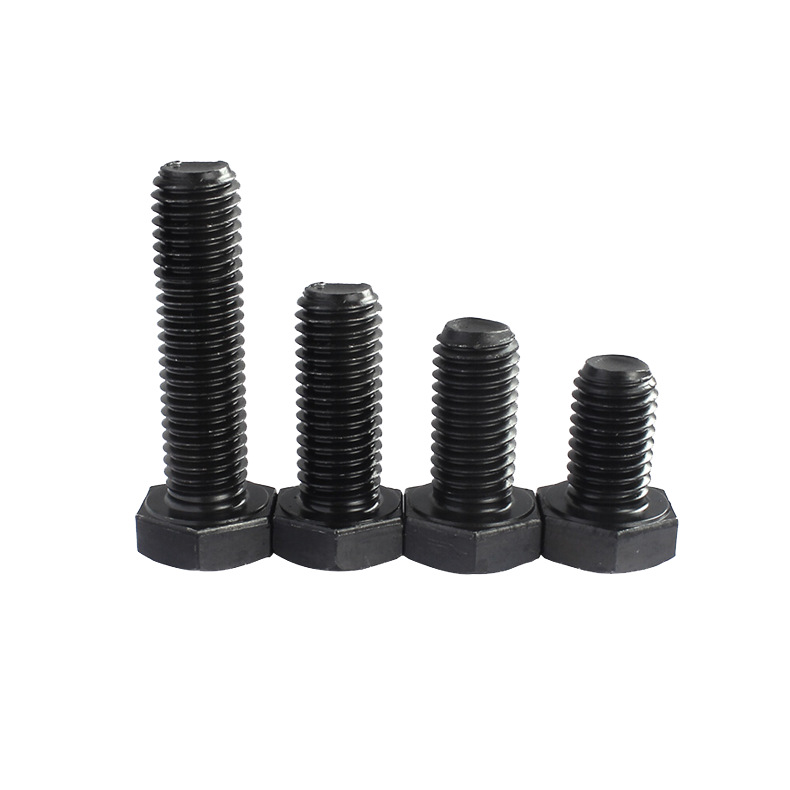
West tooth bolt
Fine teeth and coarse teeth are exactly the opposite, and are specified to
supplement the special usage requirements that coarse teeth threads
cannot meet. Fine teeth threads also have a pitch series, and the pitch of
fine teeth is smaller. Therefore, their characteristics are more conducive
to self-locking and anti loosening, and they have more teeth, which can
reduce leakage and achieve sealing effect. In some precision situations,
stainless steel screws with fine teeth are more convenient for precise
control and adjustment.
The disadvantage is that the tensile strength and strength are lower than
those of coarse teeth, and the threads are easily damaged. It is not
recommended to disassemble and assemble them multiple times. The
matching nuts and other fasteners must be equally accurate, and slight
dimensional errors can easily cause damage to both screws and nuts.
How to choose between coarse and fine threads?
Both coarse thread and fine thread screws are used for fastening purposes
Fine tooth screws are generally used to lock thin-walled parts and parts that require high anti vibration requirements. Fine thread has good self-locking
performance, so it has strong anti vibration and anti loosening ability. However, due to the shallow depth of the thread, its ability to withstand greater
tensile force is inferior to that of coarse thread.
When no anti loosening measures are taken, the anti loosening effect of fine thread is better than that of coarse thread, and it is generally used for thin-
walled parts and parts with high anti vibration requirements.
When used for adjustment, fine thread has more advantages. Disadvantages of fine thread: It is not suitable for application on materials with
excessively coarse tissue and poor strength. When the tightening force is too high, it is easy to slip the thread.
1. Application scenarios of coarse thread
The coarse thread series (M/UNC/UNRC) is generally used for mass production of threaded fasteners, such as bolts, screws, nuts, etc. It has unique
advantages in situations that require rapid assembly or disassembly, as well as in rough operations that are prone to rust and damage. But its self-
locking performance is not as good as fine and ultra-fine thread.
2. Application scenarios of fine thread
The fine thread series (MF/UNF/UNRF) is usually used in situations where high fastener strength is required. Due to the shallower teeth and larger
thread diameter of fine thread compared to coarse thread, its thread strength is higher than that of coarse thread of the same nominal specification.
Inaddition, fine thread can be used for fine-tuning occasions.