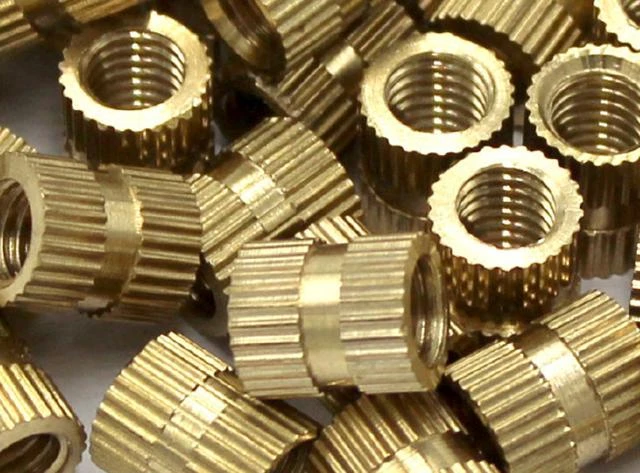
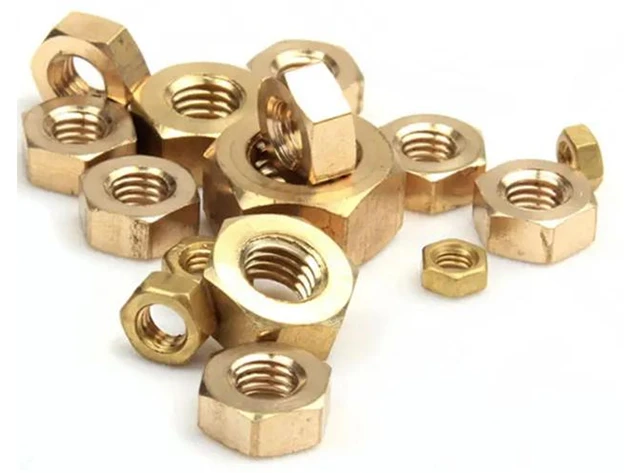
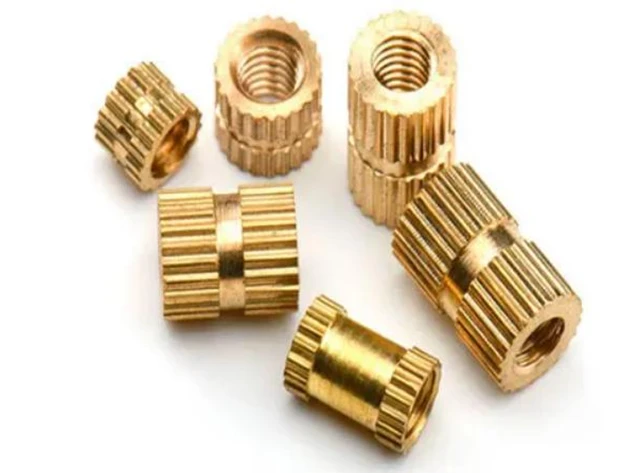
When we talk about nuts, we often think of nuts with different structural characteristics, such as hexagonal nuts, round nuts, cap nuts (nuts), flange
nuts, square nuts, lock nuts, slotted nuts, T-nuts, etc., and then we mention the material of the nuts, such as stainless steel, carbon steel, etc. However,
there is a kind of nut that everyone mentions first when consulting, and that is the copper nut.
The characteristics of copper nuts are very prominent. They are corrosion-resistant, high-temperature-resistant, highly thermally and electrically
conductive. They can also be injection molded. They are widely used in faucets, valves, electrical switches, mold injection molding and other fields.
For different applications, we will specifically say what kind of copper nuts we want, such as ordinary hexagonal copper nuts, embedded knurled copper
nuts for injection molding, etc. Here, according to the purpose, copper nuts are divided into three categories: copper nuts for machine screws, copper
nuts for set screws, and copper nuts for special purpose screws.
As the name suggests, machine screws are the screws and bolts we commonly use. They have heads and screws, such as hexagonal bolts. They can
be used with nuts or without nuts. The copper nuts used on these screws are no different from other nuts of other materials for our conventional use.
The copper nuts for set screws are used in conjunction with tightening to fix the relative position of two workpieces.
Copper nuts for special purpose screws are copper nuts used with special purpose screws, such as nuts for eyebolts, high-strength self-locking copper
nuts, nylon self-locking copper nuts, etc.
In general, the use of copper nuts is not only embedded nuts for mold injection, but other types of copper nuts are commonly used nuts, but their
material is copper.