



Rivet Nut Specifications
We offer the highest quality fasteners.
A2/A4(A2-70/A4-70(80))
DIN/ISO/National Standard/ASTM
-Almost all sizes are in stock. Quick delivery and bulk shipments.
Custom fasteners can be produced overnight if required
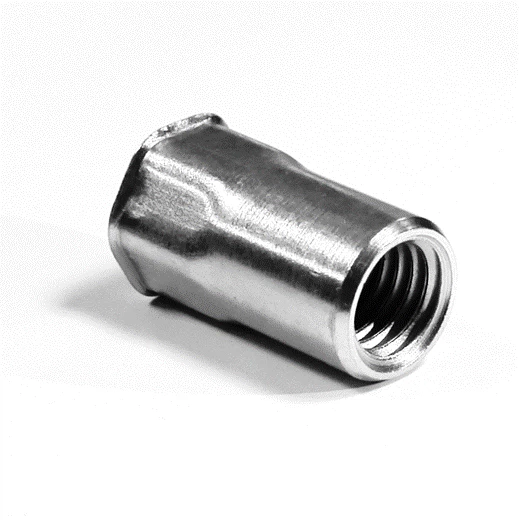 |
 |

Main features of rivet nuts
- HIGH QUALITY MATERIALS: our products are made from high quality materials such as stainless steel, galvanised steel and carbon steel. This ensures superior strength and durability, allowing them to withstand high loads and harsh conditions.
- PRECISION MANUFACTURING: Each nut is precision engineered to meet exacting specifications, providing consistent quality and reliable performance. Our manufacturing process follows strict industry standards.
- MULTIPLE APPLICATIONS: Rivet nuts provide a secure fastening solution in a variety of applications, making them ideal for a wide range of uses.
Rivet Nut Applications:
- Construction: Rivet nuts can be used to connect the metal sheets of curtain walls with the main structure of the building.
- Automotive: Rivet nuts are also used for the installation of seats, dashboards, centre consoles and other components in automotive interiors.
- Industrial machinery: rivet nuts can be used to connect different parts, such as gears, sprockets, bearings, etc. with shafts.
Detailed description
|
Rivet Nut Types |
Makings |
Typical application |
Installation |
|
Stainless steel rivet nut |
stainless steels |
Automotive, construction, machinery |
Holes are punched first and rivets are pulled to make them tight. |
|
Zinc plated rivet nuts |
zinc-coated steel |
Industrial equipment |
Holes are punched first and rivets are pulled to make them tight. |
|
Carbon Steel Rivet Nut |
carbon steel |
General construction, automotive |
Holes are punched first and rivets are pulled to make them tight. |
|
Customised Rivet Nuts |
alloy steel |
Professional applications |
Customised installation according to application |
Stainless steel rivet nut:
- Application: used for firm fastening of automobiles, construction and machinery.
- Installation method: first punch the hole, place the rivet nut, pull the rivet to make it tight.
- Advantages: High strength and corrosion resistance to ensure stability and safety.
Zinc plated rivet nuts:
- Application: For outdoor applications and environments with high corrosion potential.
- Installation method: first punch the hole, place the rivet nut and pull the rivet to tighten it.
- Advantages: Enhanced corrosion resistance, suitable for use in harsh conditions.
Carbon steel rivet nut:
- Application: Suitable for general construction and automotive applications.
- Installation: Drill holes, place rivet nuts and pull rivets to tighten.
- Advantages: cost-effective, strong support, suitable for a variety of applications.
Customised rivet nuts:
- Application: Designed for specialised applications requiring unique specifications.
- INSTALLATION METHOD: Custom installation to meet specific application requirements.
- Advantage: Custom specifications to meet unique project requirements to ensure optimum performance.
Customisation Options:
- Custom sizes: we offer standard and custom sizes of nuts to meet specific project requirements. Our advanced machining capabilities ensure a perfect fit for your application.
- Material selection: Depending on the application and environmental conditions, we offer rivet nuts made from stainless steel, zinc-plated steel, carbon steel and other specialised materials.
- Finishes: For enhanced corrosion resistance and durability, we offer a variety of finishes including zinc-plated, galvanised and custom coatings.

The production process of rivet nut:
1. Material Selection: Select the suitable material according to the required strength and environmental conditions.
2. Cutting: Cut the material into the required shape and size.
3. Forging or Cold Heading: Pressure is applied to the raw material through the die of the cold heading machine to quickly upset and extrude it into the basic shape of the rivet nut.
4. Threading: Creating precise threads to ensure a firm fastening.
5. Heat Treatment: Increase the hardness of the nut and adjust the toughness of the nut.
6. Surface treatment: Apply anti-corrosion coating. 7 .
7. Quality Inspection: Ensure that each nut meets strict quality standards.
8. Packaging: Packaging the finished nuts for shipment.
Global standards for rivet nuts:
Rivet nuts are manufactured and used around the world, adhering to various international standards to ensure compatibility and performance. Key standards include:
- ISO (International Organisation for Standardisation): ISO 898-1 provides guidance on dimensions, materials and mechanical properties to ensure global compatibility.
- DIN (German Standards Institute): DIN 787 outlines specifications for rivet nuts used in Europe, focusing on dimensional and material requirements.
- ANSI (American National Standards Institute): ANSI/ASME B18.2.1 specifies the North American standard for rivet nuts, detailing size and shape requirements.
- JIS (Japanese Industrial Standards): JIS B 1180 defines the characteristics and test methods for Japanese rivet nuts to ensure quality and performance.
Common pairs of rivet nuts:
Rivet nuts are usually paired with various fasteners to ensure a safe and reliable connection.
- Bolt: Widely used in sheet metal processing industry, such as electrical control cabinets, communication equipment chassis and other thin plate structure assembly.
- Sheet metal: Rivet nuts are commonly used in the fast fixing of sheet metal, without welding, can be repeatedly disassembled and fixed.